


 Email: support@roboticsbydrkhatri.com
 Call: +918696097555

Recent Advances in Medical Research Transforming Joint Care Practices
Posted By Robotics By Dr. Khatri • Jul 11, 2026
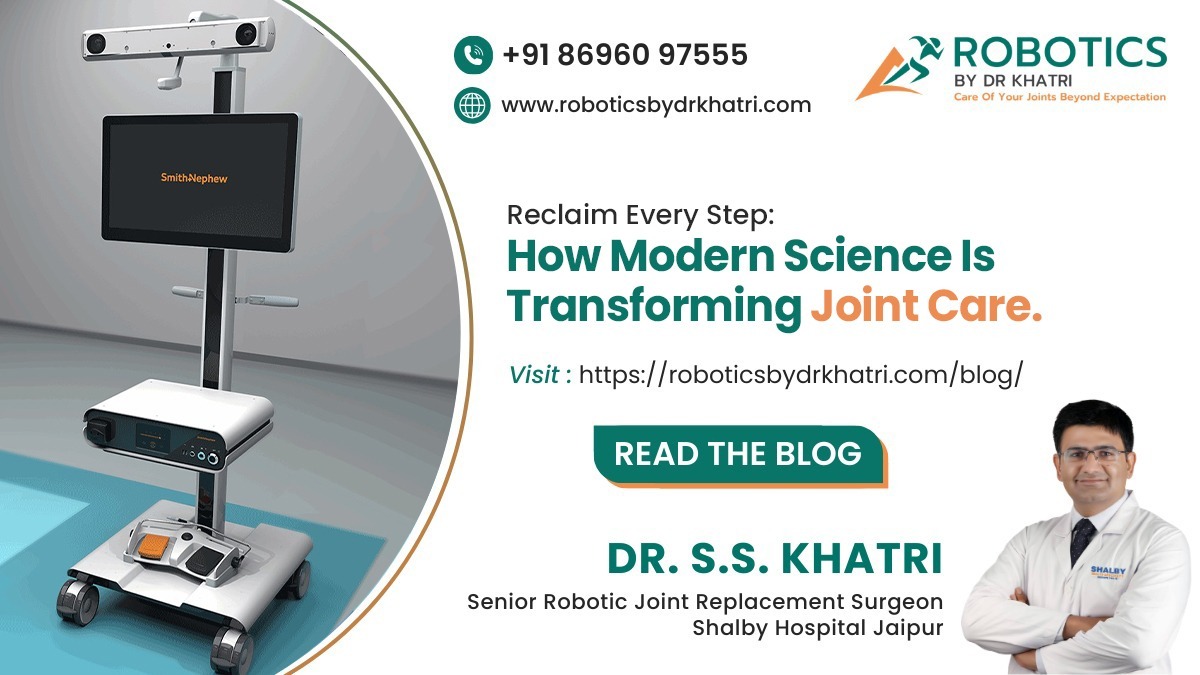
What would it be like to have each step that you take without feeling pain, like reclaiming your freedom? For individuals who suffer from joint pain, such a dream is turning into reality through the efforts of medical researchers. With better diagnosis and treatment methods, recovery for joint-related conditions is now faster and more effective than ever before. Today, many people are looking for the best knee replacement surgeon in Jaipur.
The treatment of joints has undergone many transformations in the past few years. The scientists are working on making better joint implants as well as recovery methods for individuals. They are also creating individualized treatment plans based on an individual’s body requirements and their lifestyle needs. All of this is done to ensure the least amount of pain, quick recovery, and ease of movement.
Various Recent Advances in Medical Research Transforming Joint Care Practices
Joint treatments have greatly progressed owing to medical research. Improved methods of diagnosis and surgery are aiding the patients to recover faster and resume their normal activities without any difficulty and with much less pain.
• Robotic-assisted knee replacement for better precision
Robotic technology for knee replacement surgery is an important advancement in joint management. With the help of robots, the doctor can make a 3D map of the knee joint, which helps plan for the procedure very well. It will help improve the positioning of implants and balance soft tissue, thereby improving recovery as well. Patients who are looking to have the top knee surgeons in Jaipur ask about robotic technology.
• Advanced imaging for accurate diagnosis
With the advancement in imaging technology, diagnosing any joint problem has become an easier task. With high-resolution MRIs, 3D imaging, and computer analysis, doctors are now able to diagnose joint disorders with greater clarity. Beforehand, a patient could have been subjected to various tests to determine their exact problem.
• Navigation technology is improving surgical accuracy.
Computer navigation aids help doctors in joint surgery by giving them information about joint position. The computer navigation aid is just like a parking sensor system used in a car. The doctor controls everything, and the computer navigation provides assistance for more precise results. A patient who needs a top knee replacement surgeon in Jaipur always looks for someone who is experienced in using computer navigation aid technology.
• Minimally invasive surgical techniques
Current joint surgeries strive for minimal harm to tissues. With the minimally invasive approach, doctors make small incisions in order to access the problematic site. People may experience less discomfort, bleed less, and be able to get back to work quicker. The major idea behind this is the ability to achieve surgical outcomes with easier recovery.
• Improved pain management after surgery
Joint replacement recovery has been made easier due to greater knowledge of how to control pain. Instead of just using very powerful painkillers, current strategies use more than one method at the same time. These can be nerve blocks, specific pain killers, and movement programs.
Conclusion
The care of joints has improved with the use of technology, which has helped patients through robotics, AI, advanced implants, and rehabilitation. The advancements provide a better treatment modality. Optimum results can be achieved by integrating technology, surgery, and a proper rehabilitation process of the joints.
Recent Blogs
Recent Advances in Medical Research Transforming Joint Care Practices
Recent Advances in Medical Research Transforming Joint Care Practices

Recent Advances in Medical Research Transforming Joint Care Practices
Recent Advances in Medical Research Transforming Joint Care Practices
Follow Us On


